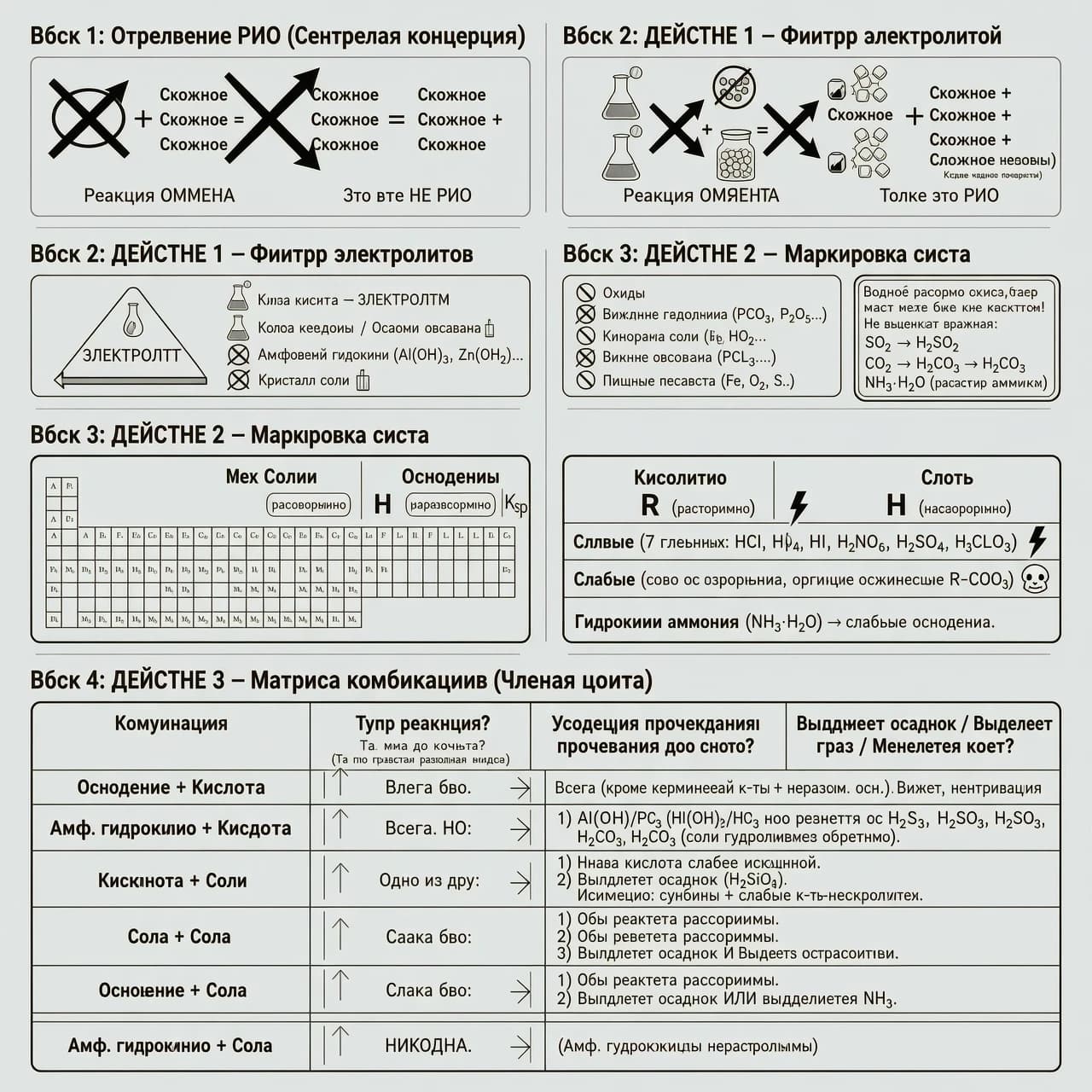
Create an infographic - educational material on the text I will send. Visually clear and illustrative. Restrained. Official language and scientific terminology. Understandable for schoolchildren. Not small print. Block 1: Definition of RIO (Central Concept) Visual: Two intersecting arrow diagrams. Left: crossed-out diagram 'Complex + Complex = Complex' (label: This is NOT RIO). Right: working diagram 'Complex + Complex = Complex + Complex' (label: Only this is RIO). Text conditions at the bottom of the block: Reaction of EXCHANGE (minimum two products - complex substances). Both reactants are ELECTROLYTES. Block 2: ACTION 1 - Electrolyte Filter Visual: A sieve labeled 'ELECTROLYTE', with some icons passing through and others getting stuck. Pass (keep): Acid drop 🧪 Flask with alkali / Base precipitate ⚗️ Amphoteric hydroxide (Al(OH)₃, Zn(OH)₂...) Salt crystal 🧂 Cross out (discard from diagram): Oxides (prohibition sign on SO₂, CO₂, P₂O₅... but with a small print note nearby: 'Except for aqueous solutions!') Binary compounds (PCl₃, H₂O₂...) Simple substances (Fe, O₂, S...) Important inset (Warning banner): An aqueous solution of an oxide/gas can be an acid! Do not cross out immediately: SO₂ → H₂SO₃ CO₂ → H₂CO₃ NH₃·H₂O (ammonia solution) Block 3: ACTION 2 - Strength Marking Visual: Periodic table schematically divided into zones under formulas of salts and bases. Under salts and bases: Write the label 'R' (soluble) or 'N' (insoluble). Ksp reference icon (solubility tables). Under acids: Write the strength. Strong (7 main ones: HCl, HBr, HI, HNO₃, H₂SO₄, HClO₄, HClO₃) — mark with a lightning bolt ⚡. Weak (all others, organic R-COOH) — mark with a skull 🐢. Ammonium hydroxide (NH₃·H₂O) — weak base. Block 4: ACTION 3 - Combination Matrix (Main Part) Visual: Matrix diagram where two check arrows lead from each pair of electrolytes. Direction 1 (Reaction Type): Exchange to completion? (Yes/No according to the rules in the table below). Direction 2 (Condition of Assignment): Precipitate forms / Gas evolves / Color changes? Combination Conditions for completion Base + Acid Always (except silicic acid + insoluble base). Visual: neutralization. Amphoteric hydroxide + Acid Always, BUT: Al(OH)₃/H₃PO₃ do not react with H₂S, H₂SO₃, H₂CO₃ (salt hydrolyzes back). Acid + Salt One of two: 1) New acid is weaker than the original. 2) Precipitate forms (or H₂SiO₃). Exception: sulfides + weak non-oxidizing acids. Salt + Salt Immediately both: 1) Both reactants are soluble. 2) Precipitate forms. Base + Salt Immediately both: 1) Both reactants are soluble. 2) Precipitate forms OR NH₃ evolves. Amphoteric hydroxide + Salt NEVER. (Amphoteric hydroxides are insoluble).